With the score of Game 5 in a phenomenally competitive series between the Trail Blazers and Thunder knotted at 115, all I could think was: “He’s gonna run out of time.”
After 47 wildly entertaining minutes, Damian Lillard had the ball and a chance. He’d authored a historic, wreathed-in-flames first half, outdueling Paul George and Russell Westbrook to stake Portland to a nine-point lead late in the third quarter.
He’d seen that advantage disappear in a puff of smoke, as Oklahoma City surged behind an energetic and effective small-ball unit with Jerami Grant at center to go up by 15 with seven minutes to go. He’d pushed Portland back to level, with the help of some huge buckets from CJ McCollum and four clutch free throws by Maurice Harkless. Then, with the shot clock turned off, Lillard stared down George from the edge of the Blazers’ half-court logo, dribbling the seconds away.
“He’s two steps inside half court, he hasn’t even started his move, and there’s 3.5 seconds left,” I thought. “What’s he doing? He’s gonna run out of time.”
I should’ve known, though. Time is sort of Damian Lillard’s specialty.
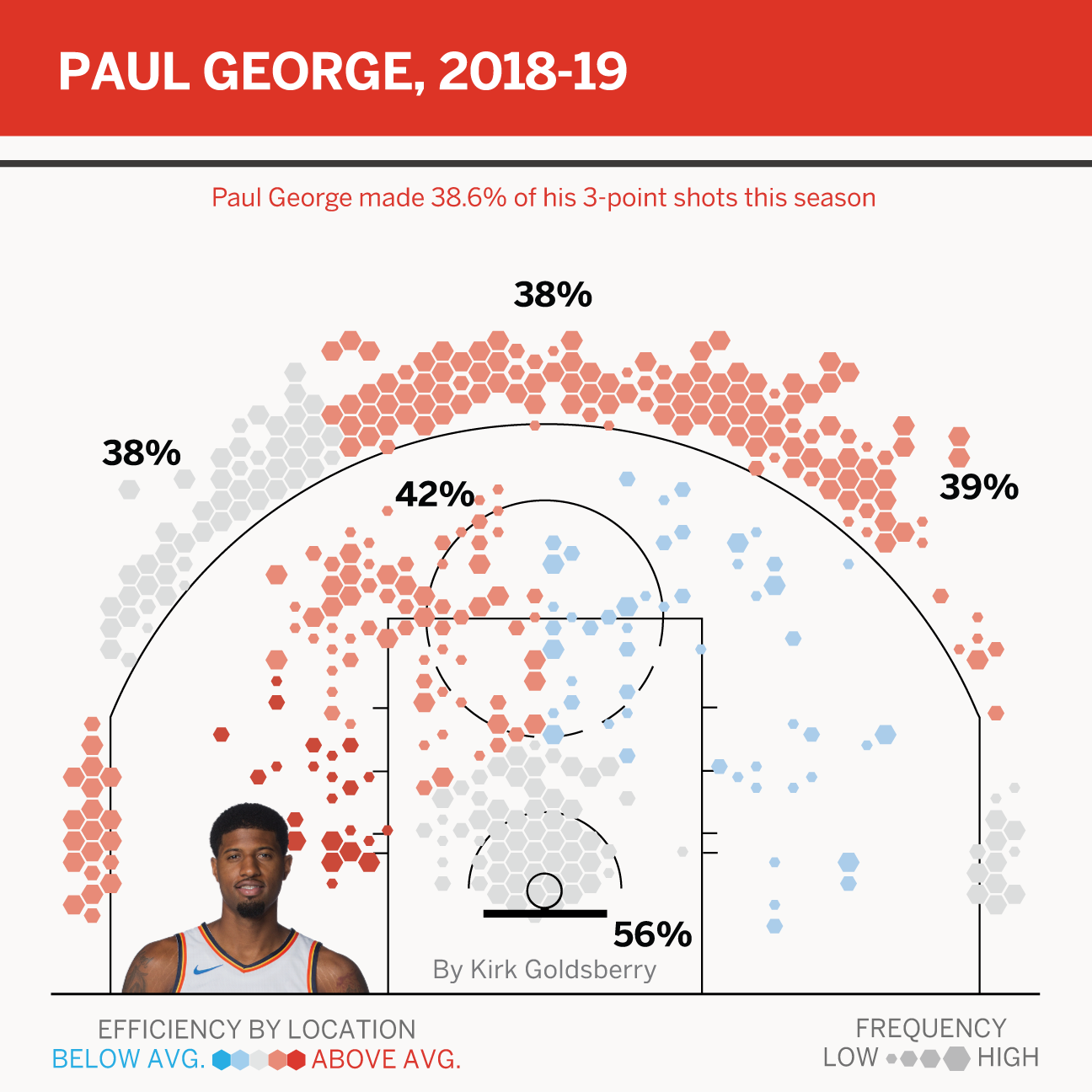
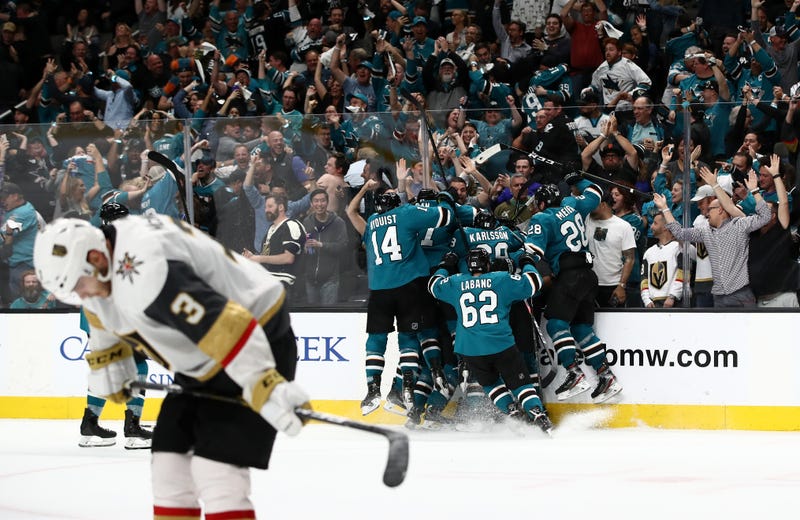
A left-to-right dribble, a slide step to the right, and that’s all it took. George, one of the best perimeter defenders in the world, jumped as soon as he saw Lillard begin to pull up, and extended his right arm as far forward as he could, but it wasn’t far enough. The shot was away, and it was pure, and it was in, with nothing but zeroes—fitting—on the clock. Blazers win, 118-115. Blazers win, four games to one. Time to pack up and go, Thunder. Get home safe.
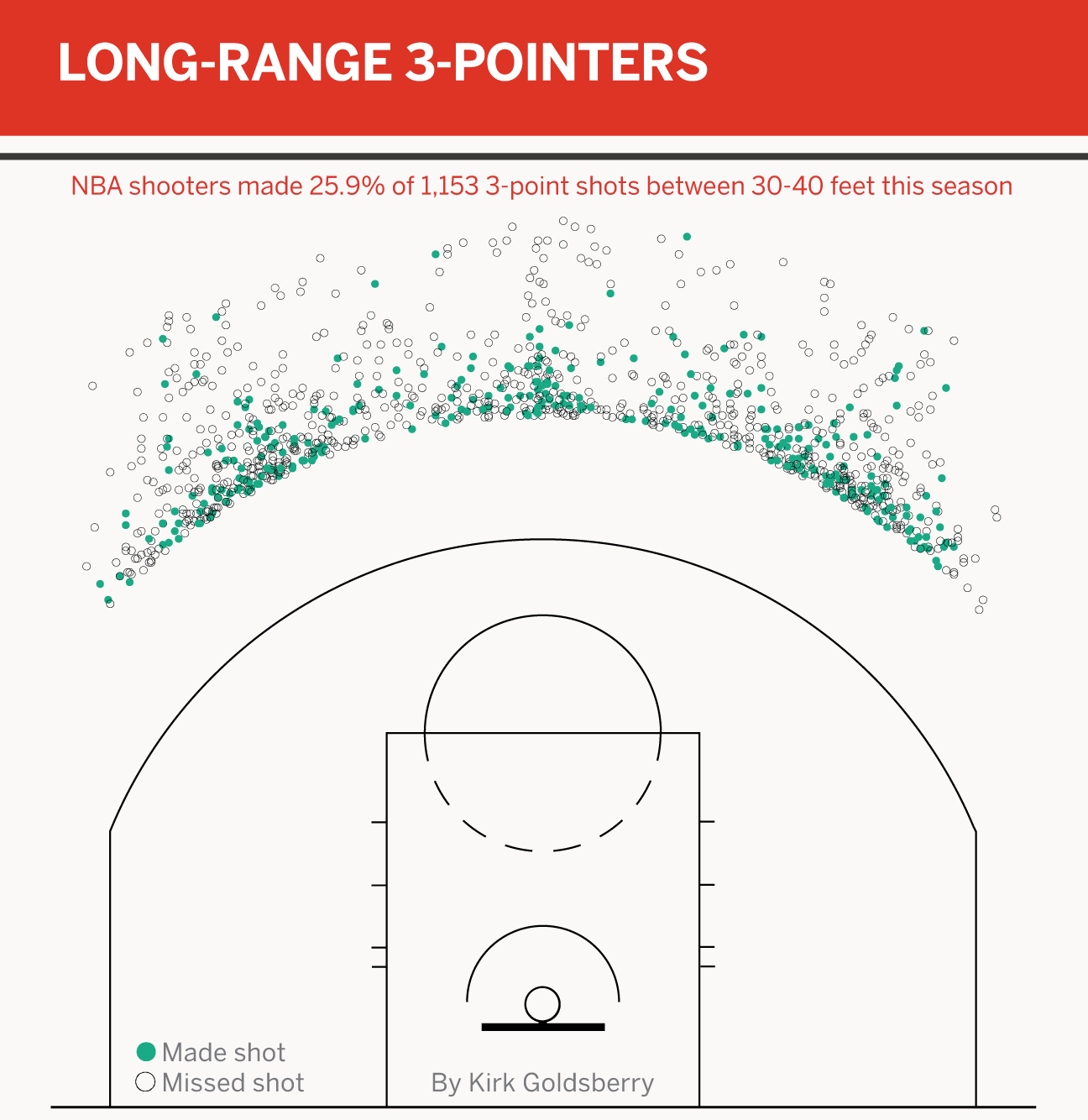
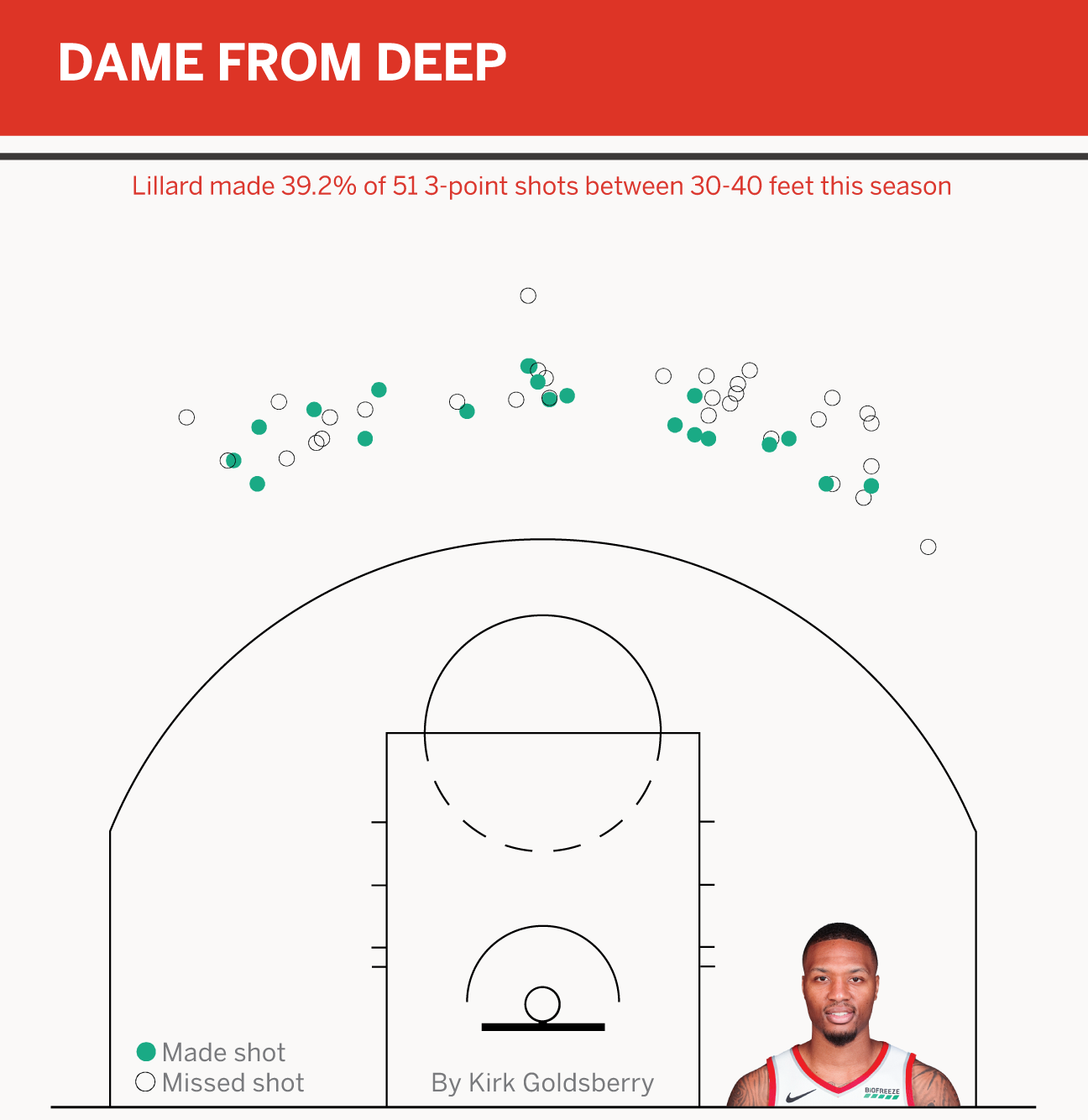
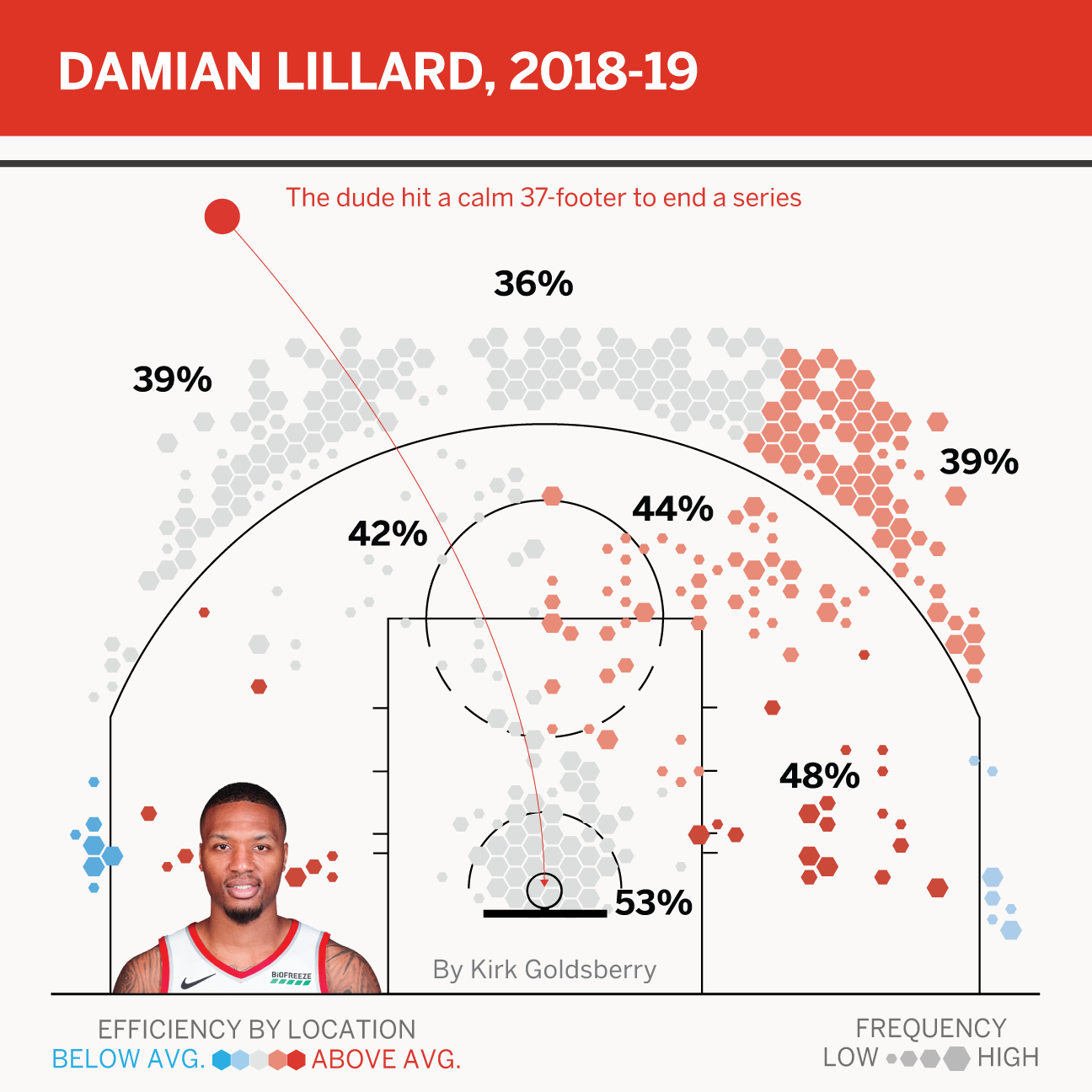
“That’s a bad, bad shot,” George groused after the game. Except that, in Lillard’s hands, in this series, it wasn’t: He took five shots from 30-plus feet in Round 1 … and made all of them. No wonder he looked so placid afterward; the only person who wasn’t surprised that Dame made the shot was Dame himself.
That 36-foot, step-back, series-winning missile gave Lillard an even 50 points in Game 5 on 17-for-33 shooting, setting a new personal playoff high and a new Blazers single-game postseason franchise scoring record. (He added seven rebounds, six assists, three steals, and a block in 45 unforgettable minutes.) It made Lillard just the 24th player in NBA history to hang half-a-hundred in a playoff game, and only the second to make 10 3-pointers in one. (Westbrook and Thunder coach Billy Donovan likely remember the first all too well.) And the first to drill a buzzer-beating game-winner to clinch a playoff series since … well, himself, against the Rockets in 2014.
Do you remember what Lillard said back then, just after he’d ripped Houston’s heart out in Rip City? Fresh off the icepick dagger that introduced him to the broader basketball world as an ascendant superstar, he said, matter-of-factly, “That’s definitely the biggest shot of my life—so far.”
That ranking now needs a rewrite. After three first-round exits in four postseasons and consecutive sweeps that threatened to break him and his Blazers, five years after the moment that made him, Lillard now has another. And holy shit, is it a great one.
“After last year, I kept telling people: Sometimes, it’s just your turn to go through something,” he told TNT’s Stephanie Ready on the court after the rapture. “And when you keep fighting, and you keep working through it and stay together, it’s a reward waiting for you. We kept working, and I think this is the beginning of our result.”
If Tuesday marked a new beginning for Lillard and the Blazers, it also felt like an inflection point for their counterparts.
Oklahoma City still hasn’t won a playoff series since Kevin Durant bolted to the Bay. In 2017, you could chalk up the team’s first-round loss to Westbrook, who had earned MVP honors for carrying a lacking post-Durant Thunder roster to 47 wins, being totally outgunned in a matchup with James Harden’s 55-win Rockets. Last season’s model featured more firepower, but you could still kind of write off an opening-round loss to the young and hungry Jazz as the grim but natural outcome of the unsuccessful science experiment of adding an about-to-enter-free-agency George and a fading Carmelo Anthony.
This season was supposed to be different. Melo was gone, swapped for Dennis Schröder and replaced in the starting lineup by Grant. George was back with a clear head after committing to a four-year max deal to forge a long-term partnership with Westbrook. The Thunder looked for four months like a real challenger for Western supremacy, thanks to George’s MVP-level play, an elite defense, and Westbrook’s force of will. But then George’s shoulders started to buckle under all the weight they were carrying, the schedule turned nasty, and OKC stumbled into the playoffs with a sub-.500 record and negative point differential after the All-Star break.
Even so, they were favored to beat these Blazers, whom they’d swept during the regular season, and who would be entering the playoffs without center Jusuf Nurkic, Lillard’s premier pick-and-roll partner and Portland’s top rim protector. But some of the same old problems continued to rear their ugly heads: a lack of bankable shooting (only Grant and Terrance Ferguson made more than 35 percent of their 3-point tries in Round 1); a shaky roster with liabilities and question marks at nearly every position (both Markieff Morris and Raymond Felton saw rotation minutes, while Steven Adams watched the whole fourth quarter of Game 5); and the worrying deterioration of Westbrook’s jumper (he shot just 19-for-63, 30.2 percent, outside the paint against Portland).
It was a roller-coaster series for Westbrook that both showcased the most effective aspects of his game and highlighted his worst shot-jacking, rhythm-wrecking tendencies. He combined the two in Game 5. Westbrook helped OKC build an early lead by focusing on facilitating while taking a backseat to a red-hot George. But when George went to the bench with foul trouble midway through the second quarter, Westbrook predictably went into overdrive to try to fill the void; he’d go 2-for-11 from the field in the frame, missing several gimme layups and some ill-advised pull-ups.
At one point in the third quarter, Westbrook seemed reluctant to take the open looks the Blazers were giving him. Later, though, he served as the catalyst for a 15-4 quarter-ending run that gave the Thunder the lead entering the fourth. As the Blazers kept chopping down their 15-point fourth-quarter deficit, Westbrook struggled to find the right balance; on some trips, he’d defer, only to see Schröder and George come up short, and on others, he’d force the issue, leading to tough misses and turnovers. He put together another monster line—29 points, 14 assists, 11 rebounds, four steals, and two blocks in 44 minutes—but took 31 shots, missed 20 of them, and again seemed to run a little too hot for comfort, and for his team’s good, at the most critical juncture of the season. His nemesis, on the other hand, remained cool as hell.
It was clear early that Lillard was going for the knockout punch in Game 5. He scored 19 points in the first quarter, stayed on the floor to start the second rather than taking his customary rest (perhaps because early foul trouble shelved McCollum for the bulk of the half), and just kept cooking, racking up 34 points before intermission—the most in a playoff half in 14 years, and five off Sleepy Floyd’s record.
Even as he poured in wild shot after wild shot, though, it seemed like Lillard’s pulse barely quickened. He managed to lean into a maximalist offensive approach (Westbrook must have respected it, on some level) without wavering or playing on tilt. Lillard dominated this game and this series—a first-round-high 33 points per game, 48.1 percent from 3 on 10.8 attempts a night—with the confidence of a man who knew his moment had come, and who was about to derive a hell of a lot of satisfaction from ending the season of some dudes who’d talked a little too spicy a little too early for his taste.
“I think after Game 3, Dennis Schröder was out there pointing to his wrist,” Lillard told reporters after the game. “They was out there doing all these celebrations and doing all this stuff. We kept our composure and after one win that’s what they decided to do. And we was just like, ‘OK, what we want to do is win four games. And then when we win those four games, there’s not going to be nothing to talk about.’”
There didn’t need to be. Dame’s dagger spoke loudly enough.
“There’s been a lot of back and forth, a lot of talk and all this stuff, and that was the last word,” he said. “That was having the last word.”
In Oklahoma City, the talk will turn to what comes next—how to build a stronger team around the huge contracts of Westbrook, George, and Adams, whether general manager Sam Presti needs to consider tearing down what he’s put together to try to build something better, and what another first-round flameout means for the legacy of the 2017 MVP. In Portland, though, there’s another series to prepare for—either a trip to Denver or a visit from the Spurs. Soon enough, Damian Lillard will once again have the ball and a chance, this time to lead Portland to its first conference finals berth since 2000. Thanks to a masterful five-game performance and a shot that will live forever, the Blazers are still ticking; Dame and Co. aren’t out of time just yet.
https://www.theringer.com/nba/2019/4/24/18514096/portland-trail-blazers-oklahoma-city-thunder-first-round
2019-04-24 13:55:10Z
CBMiaWh0dHBzOi8vd3d3LnRoZXJpbmdlci5jb20vbmJhLzIwMTkvNC8yNC8xODUxNDA5Ni9wb3J0bGFuZC10cmFpbC1ibGF6ZXJzLW9rbGFob21hLWNpdHktdGh1bmRlci1maXJzdC1yb3VuZNIBdmh0dHBzOi8vd3d3LnRoZXJpbmdlci5jb20vcGxhdGZvcm0vYW1wL25iYS8yMDE5LzQvMjQvMTg1MTQwOTYvcG9ydGxhbmQtdHJhaWwtYmxhemVycy1va2xhaG9tYS1jaXR5LXRodW5kZXItZmlyc3Qtcm91bmQ